
What Are “Shake-Offs”—and What Are Dogs Telling Us?
By Krisztina Harasztosi, MSc, CDBC, ADT-IAABC, CSAP-BC
Have you ever noticed a dog shake from nose to tail after greeting another dog, walking away from a stressful situation, or finishing an exciting activity?
These “shake-offs” are often dismissed as simply drying off or shaking away stress, but emerging research suggests they may be much more. They appear to occur during moments of transition, helping dogs move from one emotional or arousal state to another.
My recently published IAABC Foundation Journal article, “Reinforcement of Shake-Off Behaviour in Dogs to Support Emotional Regulation,” grew from years of observing animals and dogs during real-life behaviour work.
I first started reinforcing spontaneous shake-offs in 2021 during reactive dog training, influenced by Grisha Stewart’s Behavior Adjustment Training (BAT 2.0), where shake-offs are described as natural reset behaviours that can be reinforced.
Over time, I started noticing patterns across different dogs and situations. Shake-offs often appeared not only after stressful moments, but during changes: moving away from triggers, stopping exciting activities, disengaging from wildlife, or returning toward a calmer state.
Most trainers recognize shake-offs, but there have been different explanations for why they happen. They have often been described as stress signals, displacement behaviours, or cut-off behaviours.
In 2024, Bryce et al. published the first peer-reviewed study specifically investigating canine shake-offs. Their findings showed that shake-offs in dry dogs frequently occurred around greetings, interruptions, and activity transitions. Their results suggested that shake-offs may not be explained only as stress signals and may also play a role during transitions between different states.
I found this possibility fascinating because it matched many of the patterns I had observed in behaviour cases. My article connects these practical observations with current research, ethology, stress physiology, neuroscience, and learning theory.
The question I explore is whether reinforcing a behaviour dogs already naturally offer may make it more available during these transition moments and potentially help support recovery.
The article discusses observations from reactive dogs and high-arousal adolescent dogs, including situations involving dog triggers, wildlife, play, frustration, and interrupted activities. It also includes case examples and videos demonstrating dogs offering shake-offs during real-life transitions.
One especially interesting and unexpected observation came from two selected cases involving a previously trained relaxation cue. These dogs were first trained with a standard relaxation protocol, where a verbal “relax” cue was associated with a relaxed state. When this cue was later used during early arousal transitions outdoors, it frequently preceded a shake-off followed by behaviours associated with returning under threshold. This was not observed when the dogs were already relaxed. While this is a very limited observation and requires further research, I found the possible connection between conditioned relaxation, arousal transitions, and shake-offs especially interesting.
These observations came from real-life behaviour work rather than controlled experiments, so the article also discusses their limitations. They are not presented as proof of a causal relationship, but as observations that create interesting questions for future research.
Many scientific ideas start this way: noticing patterns, asking questions, looking at existing research, and exploring what could be tested more formally in the future.
The full IAABC article includes the science background, practical considerations, case examples with videos, limitations, future research suggestions, and a complete reference list with links to the studies discussed.
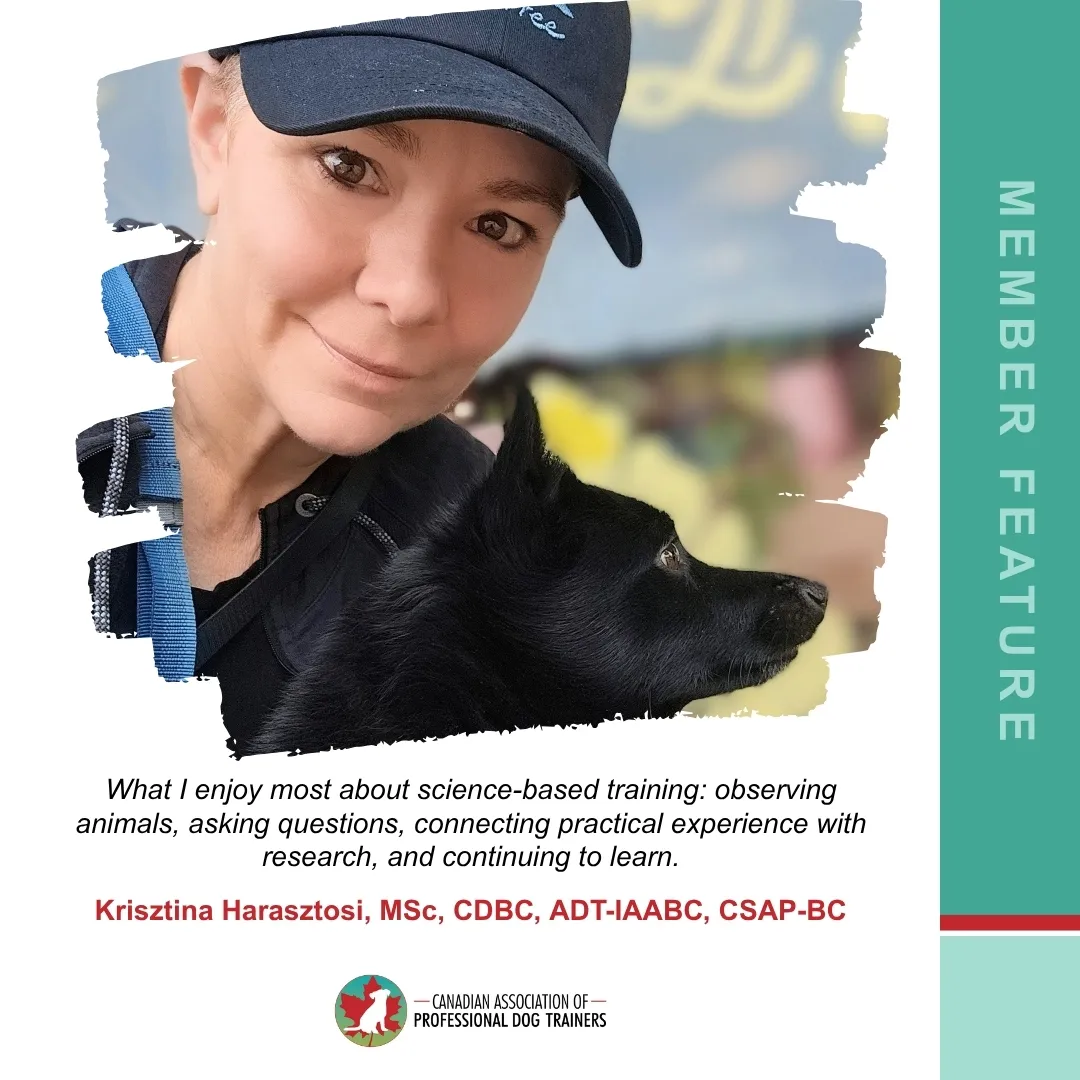
For me, this project represents what I enjoy most about science-based training: observing animals, asking questions, connecting practical experience with research, and continuing to learn.
Being part of CAPDT is important to me because I believe ethical, science-based training requires continuous education, curiosity, and open discussion. Connecting with trainers across Canada who share similar values and interests gives us the opportunity to exchange ideas, learn from each other, and continue improving the lives of dogs and the people who care for them.
Click here to read the full article
If you have any questions, comments, or would like to continue the conversation, please feel free to reach out.
I enjoy connecting with other trainers and discussing behaviour, learning, and ways we can better support dogs.
You can contact me through my website or my CAPDT member profile.
Website: https://pawsibilitieswithdogs.net/
Share Your CAPDT Story
Inspire others by showing the power of our community and how ethical, science-based dog training is making an impact across Canada.
✔ Submit a short blurb (and optional photo or video)
✔ Share how your membership has helped you
✔ Tell us what you value most about being part of CAPDT
We’ll be featuring members throughout the year in newsletters, social media, and on our website.