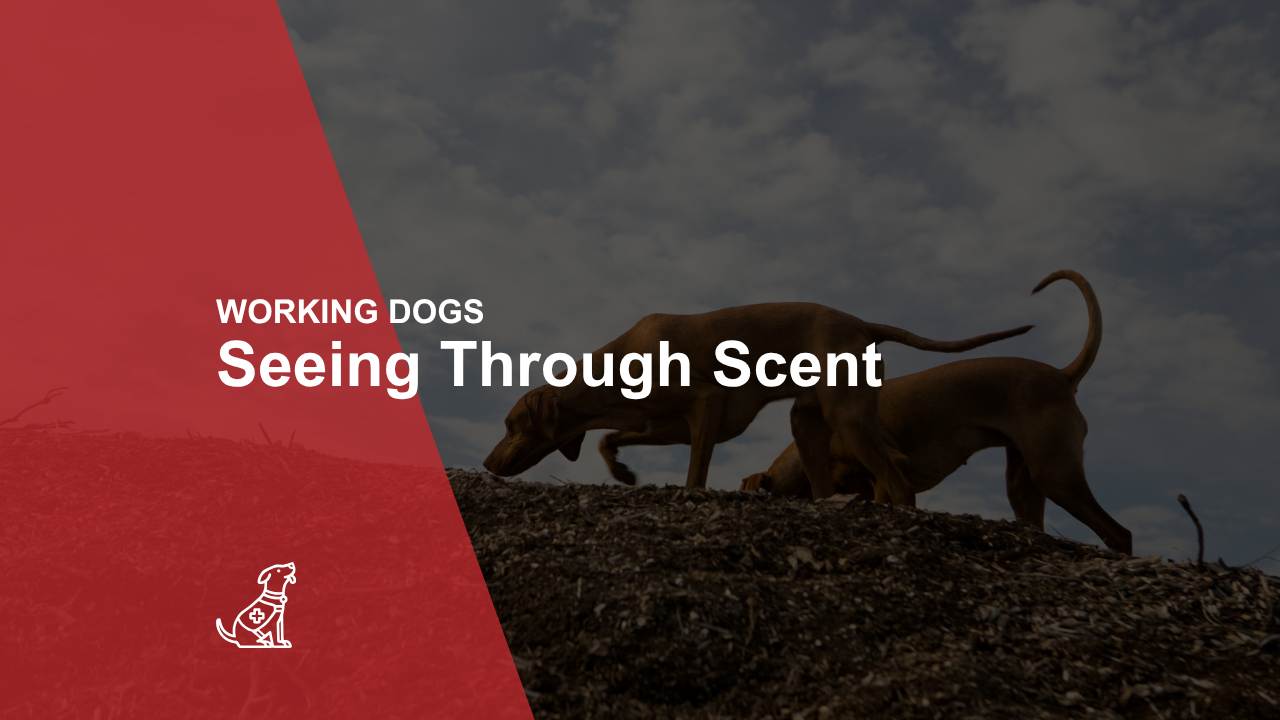
A simple walk outside for us humans is much more complex for a dog. It’s filled with information; what animals have passed through, where food may have been and even what’s changed since their last visit. They can tell all this through scents. Dogs rely heavily on their sense of smell to gather information about their environment which is what makes scent work one of the most natural and rewarding activities we can offer them.
Scent detection dogs take this natural ability and refine it into a trained skill. These dogs can locate specific odours ranging from explosives, narcotics, human remains, wildlife and even more targets. Search-and-rescue teams, law enforcement agencies and working dog organizations rely on these abilities every day.
Understanding Different Types of Scent Work
Although detection, tracking, trailing and air scenting are sometimes used interchangeably, they do describe different scent skills.
Detection dogs are trained to locate a specific target odour and communicate when they have found it. The goal is to locate the source of the scent. Some common things these dogs are trained to detect are explosives, narcotics, human remains, wildlife scents and medical-related odours. In detection work, the dog learns that a particular scent has meaning and that finding it results in a reward from their handler.
Tracking focuses on following physical disturbances like disturbed soil, bacteria, and much more left behind by a person or animal. As someone moves through an environment, they leave behind scents from skin cells, disturbed vegetation and changes to the ground’s surface. A tracking dog typically follows the path of travel more closely, often keeping their nose near the ground while following the trail left behind.
Trailing is similar to tracking but relies more on following the individual’s scent picture rather than each physical footprint. A person’s scent does not stay perfectly in one place. Skin cells and scent particles can move through the environment, creating a trail that may drift away from the exact path someone walked. Trailing dogs use this information to locate the direction of travel and follow the scent through changing environments.
Air scenting dogs work differently. Instead of following a specific ground trail, they search for scent carried through the air. These dogs locate a ‘scent cone’ created as odour particles spread from a person or a source. Search-and-rescue dogs often use air scenting because they can locate a person without needing to know exactly where that person entered an area.
How Dogs Experience Scent
A dog’s nose is not simply a stronger version of ours, it is built for a completely different way of experiencing the world. When a dog sniffs, they are collecting and analyzing scent particles from their environment. Their brains are specialized for interpreting this information, allowing them to distinguish individual odours within a much larger scent picture. To us, a kitchen may smell like ‘dinner’ but to a dog, that same room may contain separate layers of information like individual ingredients, people who prepared the food, previous meals, and changes that happened throughout the day. This ability to separate and interpret scent is what allows working dogs to locate very specific odours among countless distractions.
Scent does not remain stationary and it moves, changes and interacts with the environment. Temperature, humidity, wind, terrain and surface type can all influence how scent travels. A scent trail in a forest may behave very differently from one on pavement or inside a building. Wind can carry scent away from its original location, creating challenges and opportunities for working dogs. A skilled handler learns to consider airflow, terrain, and environmental conditions while allowing the dog to interpret the scent information they are receiving. Weather conditions can also influence how long scent remains available. This is why scent-work handlers pay close attention to not only their dog but also the surrounding environment.
The Partnership Between Dog and Handler
A major part of scent work is not just training the dog but also the human counterpart. Dogs often communicate changes in scent before they reach the source. Handlers learn to recognize subtle shifts like a change in sniffing intensity, a sudden change in direction, slowing down or speeding up, increased searching behaviour, or even changes in body posture or focus. The handler’s job is not to tell the dog where the scent is but to recognize when their dog has found important information.
Scent work may look like a simple game of ‘find it’ but it requires intense concentration. A dog reaching for an odour must sort through competing smells, make decisions independently, ignore distractions, communicate their findings, and continue problem-solving until successful. This mental effort is why scent activities can be such valuable enrichment for pet dogs. Even simple activities like hiding treats, creating search games, or participating in beginner nose work allows a dog to engage in natural behaviours. For many dogs, using their nose provides more than entertainment, it provides confidence, independence and a sense of purpose.
References:
1. American Kennel Club (AKC) – Scent Work 101: What to Know About the Sport
Covers scent work, detection foundations, handler communication, and the role of the dog’s natural scent abilities.
2. American Kennel Club (AKC) – AKC Scent Work
Information about scent work as a sport based on professional detection dog skills.
3. American Kennel Club (AKC) – What You Need to Know About AKC Scent Work
Discusses handler skills, reading dogs, and understanding environmental factors during searches.
4. American Kennel Club (AKC) – Getting Started in Scent Work
Information about real-world detection applications and how scent work mimics working dog tasks.
5. Gould et al. – “Canine Olfactory Differentiation of Cancer: A Review of the Literature”
A review of research examining canine scent detection abilities in medical contexts.
Scent work is just one of the many ways trainers can help dogs engage in natural, rewarding behaviours. As a CAPDT member, continue exploring new training approaches, sharing knowledge with fellow professionals and bringing evidence-informed practices into your work with dogs and their people.